

Introduction
Cybersecurity threats are growing at a scary speed. Today, businesses and individuals face constant risks. You probably hear about malware, phishing, and ransomware every single day. Data breaches are no longer rare events. As our digital world gets bigger, attackers find more ways to break in. They look for any weak spot in your devices or networks.
Modern cyberattacks are very dangerous. Hackers are not just using simple tricks anymore. They use advanced tools and social engineering to win. Traditional defenses are often ineffective against them. This is because hackers have become experts at bypassing old locks. It feels like an uphill battle for most organizations.
That is why AI in Cybersecurity is such a massive game-changer. AI brings speed and intelligence to our defense. It learns as it goes. It does not just sit there waiting for a command. In this guide, we will look at how AI in cybersecurity works. We will see why old tools are failing and how the future of security is changing forever.
What is AI in Cybersecurity?
So, what is AI in cybersecurity exactly? It is the use of artificial intelligence to find and stop cyber threats. Traditional tools wait for a human to tell them what is “bad.” AI is different. It uses data to learn what a threat looks like. It can see patterns that a human might miss in a million years.
Machine learning in cybersecurity allows systems to recognize “normal” behavior. If something looks weird, the system flags it instantly. Deep learning goes even deeper. It looks at complex data to find hidden dangers. This is much better than just following a list of old rules. AI-powered cybersecurity is like having a guard who never sleeps and gets smarter every day.
Unlike old software, AI security systems keep improving. They don’t need a manual update to recognize a new virus. They adapt to new risks in real-time. This makes them the best weapon against modern hackers. It is a proactive way to keep your data safe from harm.
Why Traditional Cybersecurity Is No Longer Enough

Old security systems are mostly based on rules. They work well for threats we already know about. But what about the threats we haven’t seen yet? That is where they struggle. Today’s hackers move too fast for rule-based systems. They use “zero-day” exploits that have no known fix yet.
Hackers now use AI cyber defense tactics for evil. They use automation to attack thousands of sites at once. Human security teams are overwhelmed. There is simply too much data for a person to check. By the time a human sees a breach, the damage is already done. We need something faster.
The biggest problem is speed. Manual detection takes hours or even days. In that time, an attacker can steal everything. AI-powered cybersecurity addresses this challenge with near-instant action. We need a system that is smarter and faster than the person trying to break in.
How AI Transforms Cyber Defense
AI in Cybersecurity changes how we fight back. It isn’t just a small upgrade. This introduces an entirely new perspective. Let’s look at the three main ways AI helps us stay safe.
1. AI Threat Detection and Prevention
AI allows for real-time monitoring. It looks at your network, your apps, and even how users type. It checks huge amounts of data in the blink of an eye. Behavioral analysis in cybersecurity is a huge part of this. It learns how you usually act. If someone logs in from another country and starts downloading files, AI spots it.
Anomaly detection using AI is another tool. It identifies behaviors or activities that differ from the usual. Even if a threat is brand new, AI knows it doesn’t belong. This proactive approach stops attacks before they even start. It is a huge step up from the “wait and see” method of the past.
2. Automated Incident Response
When a threat hits, every second counts. Automated incident response is a key feature of AI. Once the system finds a virus, it acts. It can isolate a computer or block a user instantly. It does not wait for a manager to wake up and click “OK.”
This limits the damage significantly. It keeps operations going safely during a cyber incident. Continuous protection means your guard is up 24/7. AI-driven cybersecurity tools handle the heavy lifting so humans can focus on bigger problems.
3. Predictive Security Analytics
AI does more than just react. It looks into the future. By using predictive security analytics, AI finds trends. It looks at old attacks to see what might happen next. This helps companies prepare for risks before they even exist.
A proactive defense is much stronger than a reactive one. It reduces your exposure to hackers. Organizations can strengthen their security posture based on what the AI predicts. This keeps you one step ahead of the bad guys at all times.
Key Applications of AI in Cybersecurity
We see AI cybersecurity solutions in many places today. Malware detection is a great example. Old systems look for a specific “signature.” AI looks at what the file does. If a file acts like a virus, AI stops it. This helps catch new versions of malware that old tools miss.
Phishing prevention is another big area. AI uses natural language processing to read emails. It looks for signs of a scam that a human might miss. It can tell if an email is trying to trick you. Fraud detection also gets a boost. AI finds strange patterns in money transfers to stop theft in real-time.
Network security is much stronger with AI. It monitors traffic and spots unusual spikes. It also helps with endpoint protection. This means securing every phone, laptop, and tablet in a company. These AI-based threat detection methods make life very hard for hackers.
Benefits of AI-Powered Cybersecurity
There are many reasons to switch to AI-powered cybersecurity. The most obvious is speed. It finds and stops threats faster than any human could. It also improves accuracy. Old systems often flag “false positives.” This means they think a safe file is a virus. AI is far more accurate at identifying distinctions.
Scalability is another huge win. As your business grows, you get more data. Humans can’t keep up with that growth. AI systems can handle massive amounts of data without slowing down. They stay sharp no matter how much work you give them.
Over time, AI actually saves money. Automated incident response reduces the manual work for your team. You need fewer people to watch the screens. It prevents the massive costs of a data breach. All these factors make Cybersecurity with AI a smart investment for any organization.
Real-World Use Cases
In large companies, AI in enterprise security is standard. It monitors thousands of employees at once. It makes sure only the right people have access to sensitive files. In the world of AI in cloud security, it protects data stored online. Cloud environments change fast, and AI keeps up with that pace.
Banks and financial groups love AI. They use AI in financial cybersecurity to stop credit card fraud. If a transaction looks suspicious, the AI blocks it immediately. This saves billions of dollars every year. It is a vital part of modern banking.
The medical world also relies on this technology. AI in healthcare data protection keeps patient records private. Hospitals have very strict rules about data. AI helps them stay in compliance while protecting lives. These real-world examples show that AI in cybersecurity is already everywhere.
Challenges and Risks of AI-Powered Security
Nothing is perfect. AI in cybersecurity also comes with a few challenges. One big issue is data quality. AI will produce inaccurate results if it learns from flawed data. It might miss a threat or block a safe user. We have to make sure the data is clean and accurate.
Implementation costs can be high. Smaller shops might find it hard to pay for top-tier AI tools. There is also the threat of adversarial AI attacks. This is when hackers try to “trick” the AI. They might feed it fake info to make it look the other way.
Lastly, we can’t rely only on AI. We still need human experts. Overdependence can create a “blind spot.” If the AI fails and no one is watching, you are in trouble. A balanced approach is the best way to manage the risks of AI-powered security.
AI vs Hackers: The Ongoing Battle
It is important to know that hackers have AI too. They use it to automate their attacks. They can craft phishing emails that appear completely authentic. They use AI to find holes in your code faster than ever. This has turned the digital world into an AI arms race.
AI vs hackers is a constant back-and-forth. Defensive AI works to detect and block. Offensive AI works to hide and exploit. To win, your defense must be smarter than their offense. Outdated tools can’t stop today’s advanced threats. You need AI cyber defense to stay in the game.
This battle will never truly end. As the tech gets better, both sides will use it. That’s exactly why keeping up to date matters so much. You must keep your AI security systems fresh and ready for anything.
The Future of AI in Cybersecurity
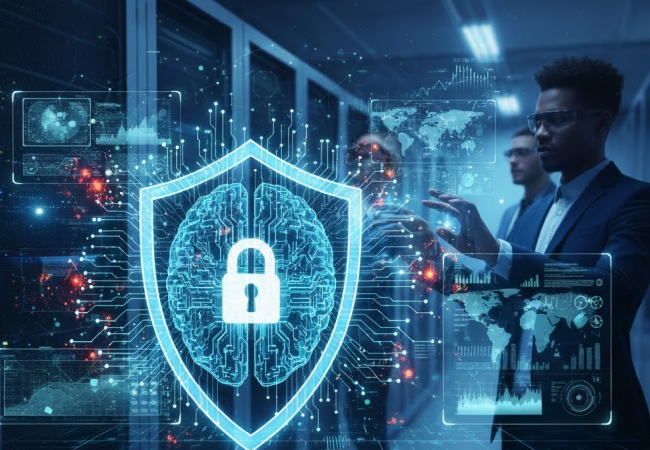
The future is very exciting. We are moving toward autonomous security systems. These are systems that can run entirely on their own. They will fix bugs and block attacks without any human help. It will be like an immune system for the internet.
We will also see more AI-driven SOC (Security Operations Centers). These centers will be much more efficient. They will use AI to sort through thousands of alerts and only show the important ones. Integration with Zero Trust and AI security will also grow. This means the system trusts no one until they are verified by AI.
Ethics and rules will play a big role too. Governments are looking at how AI is used. They want to make sure it is fair and safe. The goal is to build a digital world that is resilient and strong. AI provides the clear solution to achieve it.
Best Practices for Implementation
If you want to use AI in cybersecurity, start small. Start with tools that address your most critical challenges. Don’t try to fix everything at once. Make sure your new AI tools work with your old software. Seamless integration ensures a strong beginning.
- Choose tools that match your specific security needs.
- Train your security team to work alongside the AI.
- Monitor the AI’s performance regularly to ensure accuracy.
- Update your data sets often to prevent bias.
- Maintain a “human-in-the-loop” for critical decisions.
Training your team is vital. People need to know how to use these AI-driven cybersecurity tools. They shouldn’t be afraid of the tech; they should use it as a partner. Regular updates keep the system accurate. If you follow these steps, you will see the best results from your AI cybersecurity solutions.
Conclusion
AI in Cybersecurity has changed the world of defense. Old methods are no longer capable of handling today’s needs. Hackers are too fast and too smart. We need the speed and adaptability that only AI can provide. It is the start of a new era for digital safety.
Organizations that move to AI-powered cybersecurity now will be safer. They will be ready for the threats of tomorrow. As technology grows, our defenses will only get stronger. We are building a more resilient world, one algorithm at a time.
Are you ready to upgrade your defense? The transition to Artificial intelligence in cybersecurity is a big step, but it is the right one. Stay proactive, stay smart, and use the best tools available. The future of security is here, and it is powered by AI.




Leave a Reply