

Introduction
Honestly, a few years ago, nobody would have taken this question seriously. It would have sounded like the plot of a low-budget science fiction film. But here we are in 2026, and the question is very real.
Artificial intelligence has moved so fast that it has caught most of us off guard. It writes, it draws, it speaks, and now it creates. And when something becomes capable enough to create almost anything, it is only natural that people start asking where the line gets drawn.
So will AI create virtual adult content without humans? The short answer is that it already has started to. The longer answer is more complicated, more interesting, and honestly a little unsettling if you think about it carefully. That is exactly what this blog is here to do.
What Does AI-Generated Virtual Content Actually Mean?
Let us start from the beginning, because this topic gets confusing quickly if we skip the basics.
AI-generated virtual content simply means digital material that a machine created, not a human. No actor, no photographer, no voice artist. Just an algorithm that has consumed millions of examples of human-created content and learned to produce something new from all of it.
What can AI actually generate right now? Faces of people who have never existed, voices that could fool your own family, animated characters that express emotion with surprising realism, and conversational personalities that respond in ways that feel genuinely human. All of this is already happening today, not in some lab five years from now.
When people use the term ai virtual adult content, they are referring to that same technology being applied to simulate human presence in a very personal context, with no real human involved anywhere in the process. That is the part that makes this conversation worth having.
AI Is Not Waiting for the Future
Here’s something you might want to pause and think about for a moment. AI did not ask for society’s permission before it started changing content creation. It just did it.
Across entertainment, advertising, gaming, and social media, ai content creation tools have already replaced entire workflows that used to require teams of people. Scripts get written in minutes. Visuals get produced without a photographer. Virtual influencers rack up millions of followers without ever taking a breath.
The same tools, the same models, the same underlying technology is what powers ai generated virtual content in every other category. There is no technical wall separating one type of content from another. The only walls are ethical and legal ones, and as we will get into shortly, those walls are still being built while the technology keeps moving.
So the honest framing is not whether AI will be used in sensitive content spaces. It is already there. The real question is how deep it goes and who is paying attention.
Can AI Truly Replace a Human Here?
This is the question people really want answered, and it deserves a straight response.
Artificial intelligence adult content creation has reached a level that is technically staggering. The output can look real, sound real, and in interactive formats, even respond in ways that feel real. For someone who is not looking closely, the difference between AI-generated and human-created can genuinely be impossible to spot.
But there is a gap that matters, even if it is hard to put into words.
When a human creates something, there is intention behind it. There is experience, vulnerability, and a kind of emotional weight that comes from being a real person who actually feels things. AI lacks all of those qualities. It predicts. It patterns. It produces outputs that statistically match what it has seen before. That is impressive, but it is not the same thing.
So virtual adult content without humans is entirely possible from a technical standpoint. Whether it is equivalent to human involvement in any meaningful sense is a different question entirely, and right now the honest answer is no.
Why Is This Space Growing So Fast?
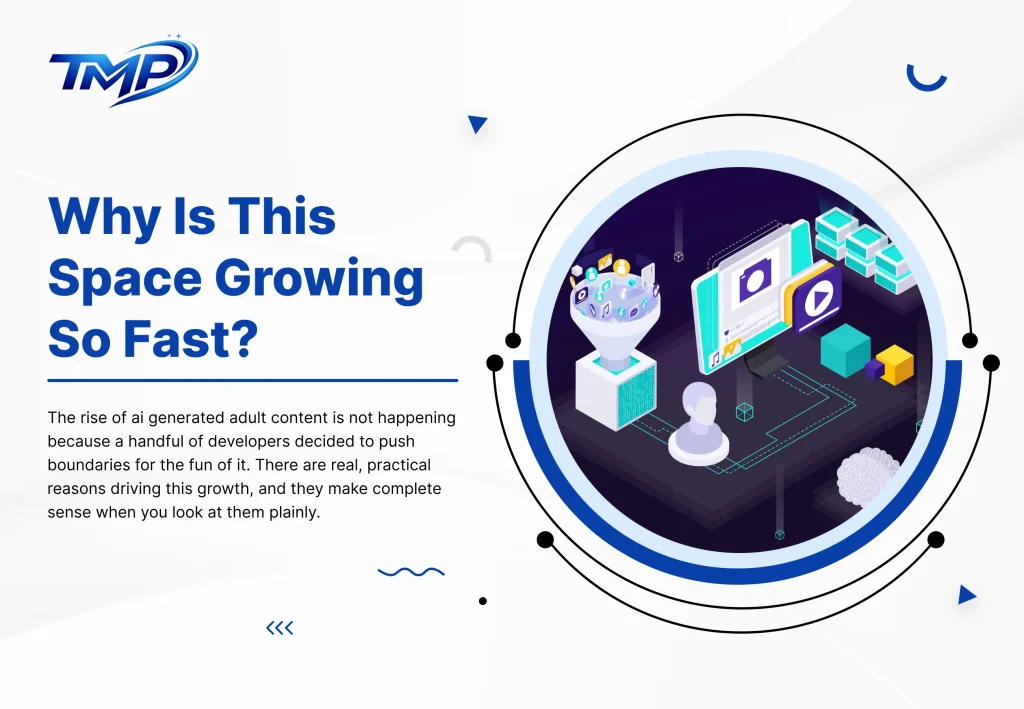
The rise of ai generated adult content is not happening because a handful of developers decided to push boundaries for the fun of it. There are real, practical reasons driving this growth, and they make complete sense when you look at them plainly.
The first is access. AI tools are now available to almost anyone with an internet connection. You do not need a studio, a budget, or a production team. A single person sitting alone can create things that would have required dozens of people and significant resources just ten years ago.
The second is cost. AI adult content creation strips away almost all the traditional expenses involved in content production. No talent fees, no equipment rental, no editing hours. For creators working independently, that changes everything about what is financially possible.
The third is privacy. Because no real person is involved in creation or performance, both the creator and the consumer feel a sense of distance from the content. Some people find that appealing. It removes a layer of complexity that real-world content always carries.
And then there is personalisation. AI generated virtual content can be shaped and adjusted to match individual preferences in ways that traditional content production simply cannot scale to. That level of tailored experience is genuinely new, and it is a powerful pull for users.
The Ethical Side That Nobody Should Ignore
Technology rarely waits for ethics to catch up, and this is a clear example of that problem playing out in real time.
The most serious concern is what happens when AI gets used to put real people into content they never agreed to. Deepfake technology makes this frighteningly easy. A real person’s face, voice, or likeness can be used to generate ai virtual adult content without their knowledge or consent. This is not a hypothetical risk. It is already happening to real people with real consequences for their lives and reputations.
Beyond identity misuse, there is the slower and quieter problem of what happens to perception over time. As ai generated images and videos become more convincing, people’s ability to distinguish real from artificial weakens. That affects more than just how we consume content. It affects how we understand reality itself.
There is also something worth thinking about regarding emotional impact. Content that is perfectly designed, always available, and completely frictionless is a very different experience from anything involving real human beings. Prolonged exposure to that kind of artificial perfection can quietly shift what people expect from real relationships, often without them even noticing it is happening.
And the legal frameworks around ai content without human involvement are genuinely behind. Regulations exist in some regions, but enforcement is inconsistent and the global nature of the internet makes jurisdiction complicated. That gap between what is possible and what is controlled is where most of the harm tends to happen.
How Does This Affect the Way People Relate to Each Other?
This is the part of the conversation that tends to get skipped over in favour of the more technical or legal angles, but it might actually be the most important part.
Digital intimacy and AI is a combination that raises real questions about human psychology. If someone has regular access to a highly personalised, always-responsive artificial experience, what does that do to their patience for the messiness of real relationships? Real people are complicated. They have moods, needs, and limitations. Real connection requires effort, tolerance, and genuine investment from both sides.
There is no research yet that definitively answers what long-term exposure to ai virtual adult content does to a person’s relational psychology. But the question is worth taking seriously before the answer becomes obvious in hindsight.
What we do know is that human connection is built on things AI cannot manufacture. Shared history, real vulnerability, genuine empathy, and the kind of trust that only forms through time and experience. Those things are not features that can be added to a model.
Where Do Laws and Regulations Stand Right Now?
The legal landscape around the future of ai in adult industry is moving, but it is moving slowly relative to the technology itself.
Several countries have introduced or are actively working on legislation specifically targeting deepfake misuse and identity-based violations. Platforms are under increasing pressure to detect and remove non-consensual AI-generated content. And in some jurisdictions, creating or distributing such material without consent now carries serious legal penalties.
But the honest reality is that enforcement remains difficult. A law passed in one country has limited reach over content hosted in another. Detection technology exists but is imperfect. And the volume of content being generated is outpacing the systems designed to monitor it.
This means that waiting for regulation to fully solve this problem is not a realistic position. Individual awareness and responsibility matter here in a way that they do not in most technology conversations.
What Might This All Look Like Five Years From Now?
The future of ai generated adult content 2026 and beyond is genuinely hard to predict with confidence, because the technology is advancing faster than most analysts anticipated even two years ago.
What seems plausible is that interactive virtual characters will become significantly more sophisticated, that real-time personalisation will reach a level of detail that feels almost indistinguishable from genuine human interaction, and that the accessibility of these tools will continue to expand rather than contract.
Whether society responds to that with thoughtful frameworks or lets it develop without guardrails is a genuine open question. Technology does not make that choice. People do.
Final Thoughts
Here is the thing about ai virtual adult content that gets lost in all the technical discussion. It is not really a technology story at its core. It is a story about what humans value and what we decide to protect.
AI is capable of extraordinary things, and that capability is only growing. Ai virtual adult content without real human involvement is already a reality in a meaningful sense, and it will become more sophisticated, more accessible, and more convincing with time.
But none of that changes what makes human experience genuinely worth something. The imperfections, the effort, the real emotional risk that comes with connecting to another person. Those things cannot be generated. They can only be lived.
The future of this space will be defined not by what AI can produce, but by the choices that humans make about what they want to encourage, what they want to protect, and where they decide to draw a line and mean it.

Leave a Reply